See your chess
through the lens of how you actually play
A desktop analysis workstation that learns your decisions, not just your positions. It understands your habits, surfaces recurring mistakes, and makes every game searchable—so improvement becomes obvious.
Your games are data.
Start using them like it.
Eval bars don't teach you how you think
Engines tell you what the best move was. They don’t tell you why you missed it—or what pattern led you there. Chess Lens goes beyond evaluation, surfacing the recurring decisions and blind spots in your play.
You can't search your own games
You've played hundreds—maybe thousands—of games. But you can't answer simple questions: Where do I actually lose? What kinds of mistakes do I repeat? How do I perform in this structure or opening? Chess Lens turns your games into a searchable dataset—so patterns aren't buried, they're obvious.
Analysis tools weren’t built for real study
Most tools live in the browser. They're fragmented, slow, and built around single games—not long-term improvement. Chess Lens is a dedicated desktop workstation, designed for focused analysis across your entire history—not one tab at a time.
Your games are scattered. Your mistakes are lost.
Games on one site. Analysis on another. Insights nowhere. There's no system tracking how you play over time—so the same mistakes repeat, unnoticed. Chess Lens brings everything together, organizing your games and surfacing the patterns you actually need to fix.
Chess Lens is a local-first analysis workstation that learns how you play. It doesn’t just evaluate positions—it tracks your decisions across games, finds recurring mistake patterns, and makes your chess fully searchable. So instead of reviewing games in isolation, you see the bigger picture—and improve with intent.
Features
Everything you need to improve
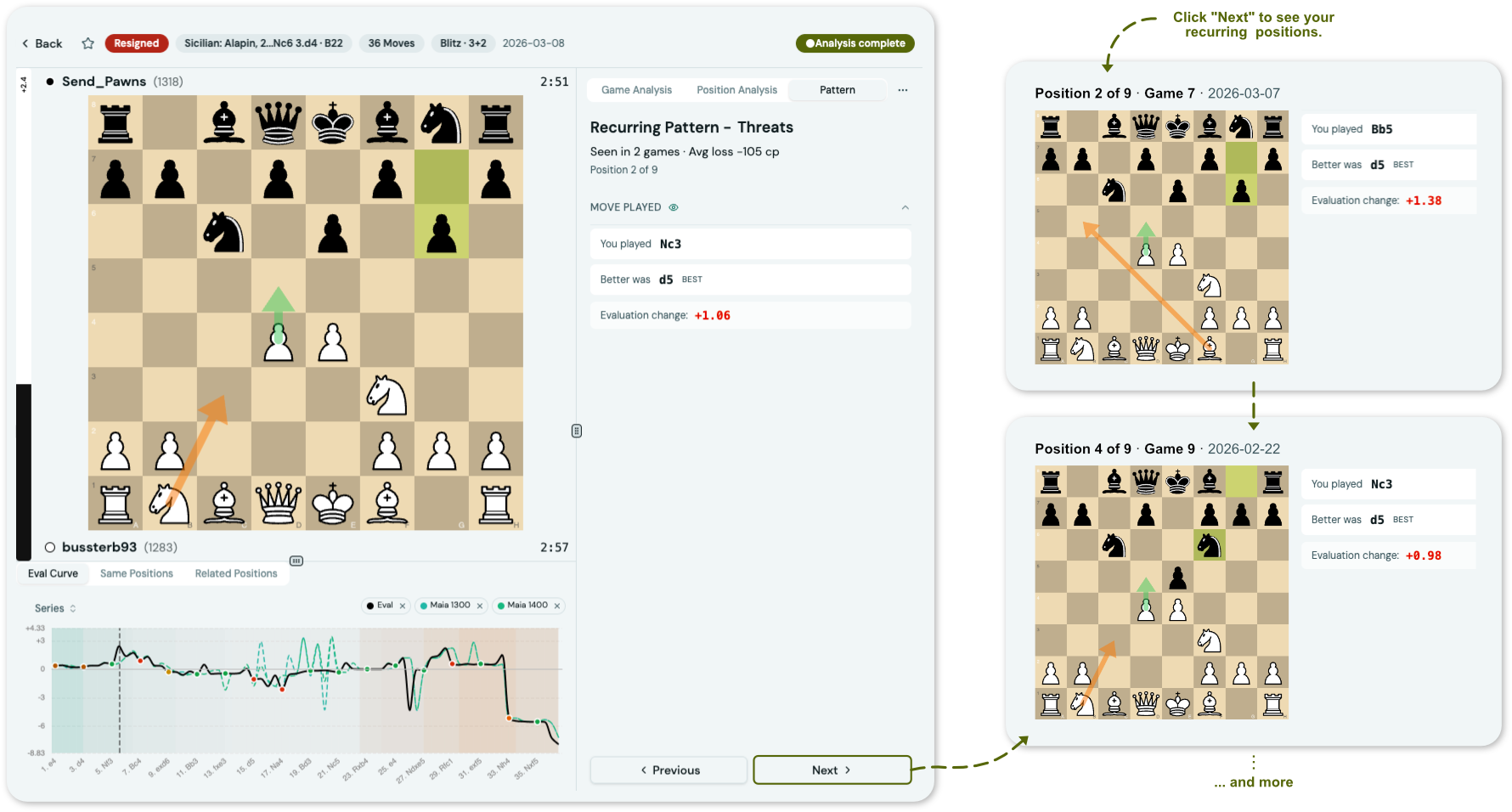
Recurring Patterns — Find What's Holding You Back
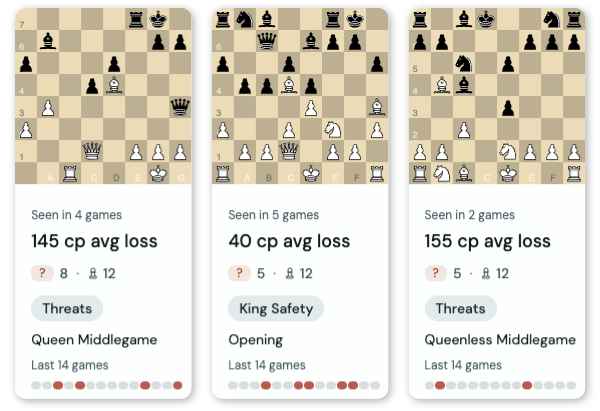
Chess Lens groups similar positions from your recent games and surfaces recurring mistake patterns. See which types of positions cause you trouble, how often they appear, and the average evaluation loss. Drill into any pattern to walk through every instance across your games — and finally answer the question: what should I actually work on?
Deep Game Analysis
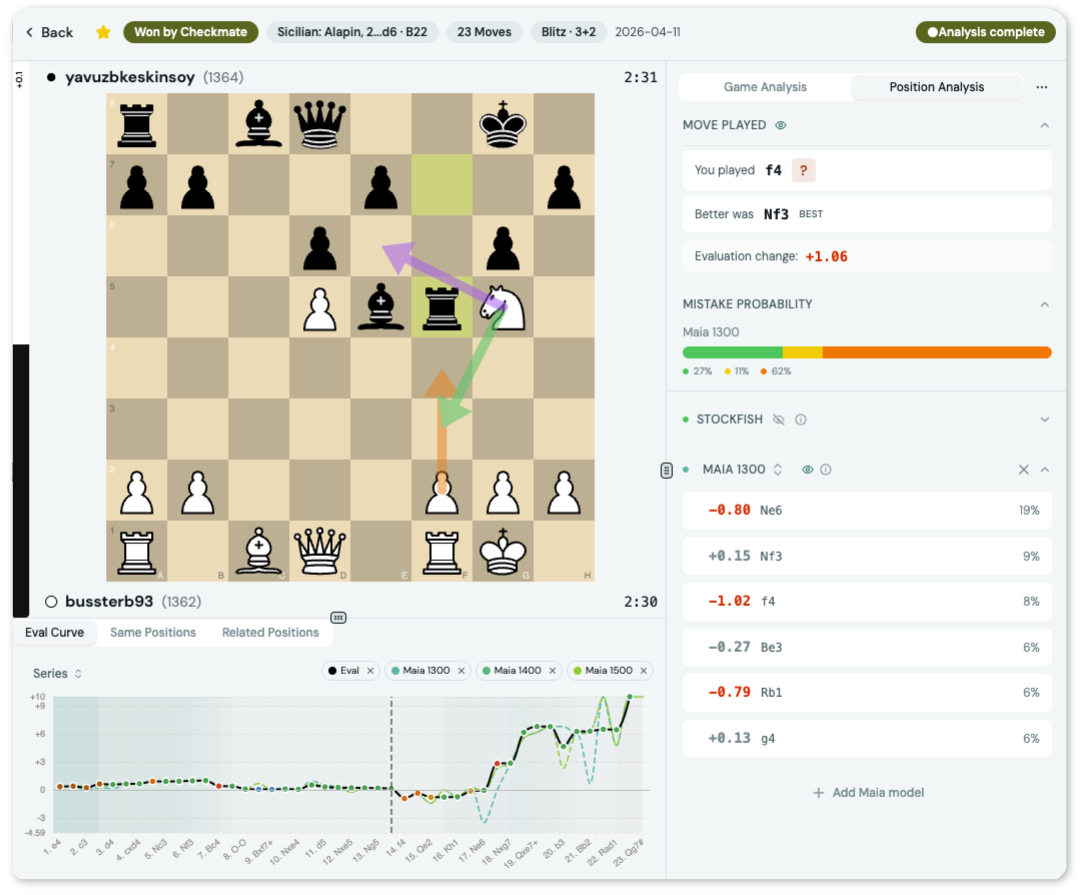
Walk through your games move-by-move with full Stockfish and Maia analysis. See your move vs. the best move with annotation arrows, an interactive eval curve with Maia overlays for ratings 1100–1900, position-level mistake probability, human move distributions, and full NAG breakdowns — blunders, misses, inaccuracies, brilliant moves, and more.
Engine + Human Fusion
Stockfish for objective evaluation, Maia for human-like predictions at ratings 1100–1900. See where your thinking diverges from both.
Automated Analysis
One-click deep analysis using your own hardware — free and fully offline. Every move classified with mistake probability and NAG annotations.
Interactive Eval Chart
Evaluation over the entire game with Maia model overlays for ratings 1100–1900. Easily spot where human players — and you — go wrong.
Games Library
All your games in a searchable, sortable, filterable data table. Filter by opponent, rating, result, opening, time control, and more. Favorite games for easy access.
Chess.com Sync
Connect your Chess.com account and sync games automatically. Lichess integration coming soon.
Resizable Workspace
PGN viewer, board, engine lines, and analysis tabs in resizable panels you can arrange to your preference.
Variation Explorer
Play out alternative lines directly on the board. Variations are persisted and analyzed, building a full game tree you can review later.
PGN & FEN Export
Export a full game PGN or copy any position as FEN for sharing with coaches, study partners, or other tools.
Local-First & Offline
Everything on your machine. No cloud dependency, no latency, no subscription to access your own analysis.
Native Desktop App
A real desktop application built for macOS and Windows. Keyboard navigation, dark mode, and a purpose-built UI for focused analysis.
How It Works
Three steps to better chess
Connect
Link your Chess.com account and sync your games. Everything stored locally on your machine.
Analyze
Run automated analysis powered by Stockfish + Maia on any game. Every move classified and annotated.
Search & Improve
Query your games, browse your positions library, and find the patterns holding you back.
Roadmap
What's coming next
Lichess Integration
Sync games from Lichess alongside Chess.com for a complete picture of your play across platforms.
Time Management Insights
Understand how you use your clock. See where you spend the most time, where you move too fast, and how time pressure affects your accuracy.
Opening Analysis
See how you handle your openings — where you deviate from theory, which lines give you the best results, and what to study next.
Opening Repertoire Tracking
Map your actual games against your intended repertoire to see where you deviate and how often.
FAQ
Common questions
Comparison
What makes Chess Lens different
vs. Lichess & Chess.com Analysis
Not just evaluation—understanding how you play Traditional analysis shows you the best move. Chess Lens goes further—combining Stockfish with Maia to model how players at your level actually think. Instead of isolated game reviews, it analyzes your entire history—making your games searchable and automatically surfacing recurring mistake patterns.
vs. Online Tools
Built for real analysis, not browser tabs Most tools are designed for quick, single-game review. Chess Lens is a desktop, local-first workstation built for deep study. No latency, no engine limits, no subscriptions—just a fast, persistent environment where your analysis, games, and insights all live together.
vs. ChessBase
Powerful without the overhead Traditional database tools require manual tagging, curation, and setup. Chess Lens does that work for you—automatically grouping positions into recurring patterns and highlighting what you should improve, without needing to manage a database.
vs. Generic Engines
Not just what's best—what's realistic Engines tell you what the best move is. Chess Lens shows how likely you were to find it. By using Maia models, it assigns mistake probability to every move and overlays human-like evaluations—so you can see not just where you blundered, but which mistakes are actually holding you back at your level.
About
Built by a chess player,
for chess players
Chess Lens is built by Jason Buss — a software engineer and chess enthusiast who got tired of existing tools not answering the questions that actually matter for improvement. This is a passion project born from real frustration with the gap between what chess analysis tools offer and what players actually need.
Interested in working together, or building something like this at scale? I'd love to hear from you.
Ready to see your chess
differently?
Download Chess Lens free for macOS and Windows. No account required.
Sign up for updates